The global synthetic paper market is projected to reach a valuation of $1.3 billion by the end of 2026, signaling a definitive shift toward high-performance substrates that bypass the need for traditional lamination. You've likely encountered the operational bottlenecks caused by ink smudging on non-absorbent surfaces or the costly damage of a substrate melting inside a high-heat laser printer. These failures aren't just inconvenient; they're a direct result of a mismatch between material composition and specific printing technology.
This professional guide ensures you master the technical specifications of synthetic paper for printing to achieve maximum durability in industrial and outdoor settings. We'll examine the specific performance differences between polypropylene and polyester bases, particularly as raw material resin costs and new EPR regulations in states like Maryland and California reshape the 2026 supply chain. You'll learn how to identify tear-proof, waterproof media that's fully compatible with your specific offset or digital equipment. This analysis provides the data required to eliminate secondary lamination costs and select the optimal substrate for long-term resilience and professional-grade results.
Key Takeaways
Understand the fundamental material differences between absorbent wood-pulp and non-porous petroleum-based resins to prevent ink failure and substrate degradation.
Evaluate the performance trade-offs between polypropylene and polyester substrates to match material flexibility and heat resistance with your specific application.
Master the technical requirements of synthetic paper for printing, including the necessity of static dissipative coatings for high-speed digital presses.
Identify high-stakes industrial environments where waterproof, tear-resistant media eliminates the operational costs of secondary lamination.
how to select the correct mil thickness and rigidity standards to ensure seamless printer compatibility and long-term substrate stability.
Defining Synthetic Paper: Beyond Traditional Wood-Pulp Media
Synthetic paper is a precision-engineered substrate manufactured from petroleum-based resins rather than organic wood fibers. While traditional paper relies on a felted web of cellulose, synthetic paper for printing is typically produced through an extrusion process using Biaxially Oriented Polypropylene (BOPP) or high-density Polyethylene. This material science creates a non-porous, monolithic structure that is fundamentally different from the absorbent, capillary-driven nature of wood-pulp media. By 2026, industrial standards have shifted toward these tree-free substrates to meet both extreme durability requirements and the rigorous reporting demands of new Extended Producer Responsibility (EPR) regulations in states like California and Maryland.
The Chemistry of Ink Adhesion on Non-Absorbent Paper
Traditional wood-pulp paper facilitates ink drying through physical absorption; the liquid carrier is pulled into the fibrous gaps. Synthetic substrates lack this internal volume, meaning standard offset or aqueous inks will simply sit on the surface and smudge. To solve this, specialized top-coatings are applied during manufacturing to facilitate chemical bonding. These coatings act as an anchor for pigments and toners, ensuring high-fidelity reproduction without the risk of delamination. Without these specialized treatments, the lack of physical absorption prevents the ink from ever reaching a stable, dry state.
Core Benefits for High-Traffic Environments
The mechanical strength of synthetic media provides a level of resilience that wood-pulp cannot match, even when heavily coated. In high-traffic commercial settings, the inherent waterproof and grease-proof properties mean that documents remain legible despite exposure to chemicals, oils, or submersion. It's a heavy-duty solution for environments where traditional materials fail.
Dimensional Stability: Synthetic sheets don't swell, warp, or curl when exposed to high humidity or direct water contact.
Tear Resistance: The cross-linked polymer chains prevent edge-fraying and dog-earing in frequently handled technical manuals.
Lamination Removal: Transitioning to Synthetic Waterproof Paper allows businesses to bypass the secondary lamination phase entirely.
Eliminating the lamination process reduces labor costs and removes the risk of peeling at the edges over time. For 2026 production cycles, this efficiency is critical as businesses balance rising resin costs with the need for archival-quality industrial documentation. The result is a robust, single-layer solution that maintains its structural integrity in environments that would destroy traditional paper within hours.
Polypropylene vs. Polyester: Choosing the Right Synthetic Base
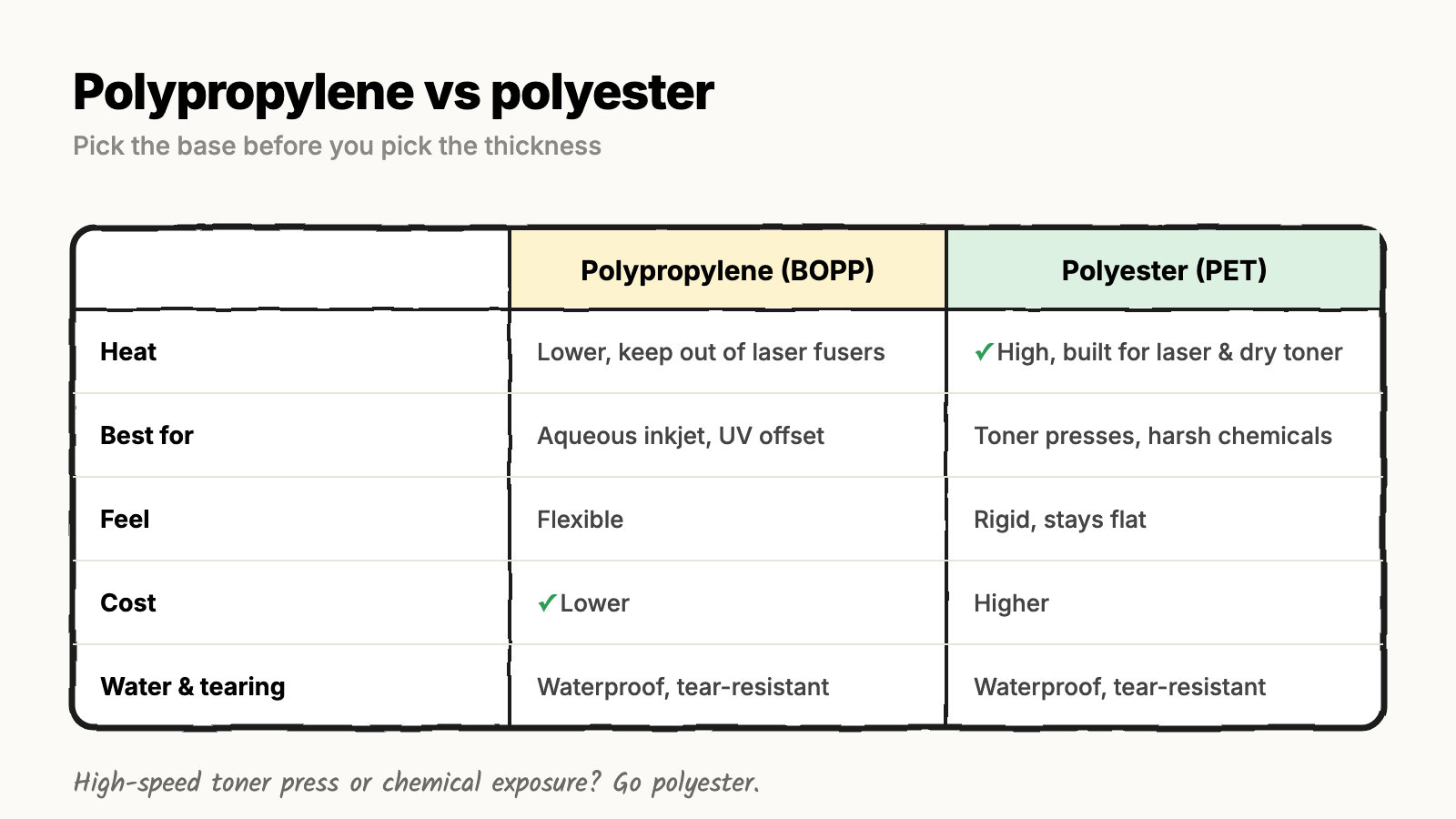
The performance of synthetic paper for printing is dictated primarily by its polymer base. While general paper merchants often categorize these materials under a single "plastic" label, professional applications require a clear distinction between Polypropylene and Polyester. Choosing the wrong substrate leads to catastrophic failures, such as material melting in laser fusers or ink delamination in outdoor environments. 4S Graphics maintains a specialized inventory of both polymer families to address these specific technical requirements with precision.
Polypropylene (BOPP) Characteristics
Biaxially Oriented Polypropylene (BOPP) is the most prevalent material in the synthetic market. This substrate is produced by stretching the polypropylene film in both machine and transverse directions, which significantly increases its mechanical strength and tear resistance. It is a cost-effective, flexible solution ideally suited for aqueous inkjet or UV offset printing. However, BOPP has a relatively low melting point. It is not recommended for high-heat digital laser printers where fuser temperatures can exceed the material's thermal threshold. Common industrial use cases include durable labels, temporary outdoor banners, and retail signage where flexibility is a priority.
Polyester (PET) and Rigid Polyester Paper
Polyester (PET) offers superior thermal stability compared to polypropylene. This material is engineered to withstand the intense heat of dry toner and high-speed laser printing without curling or shrinking. Its molecular structure provides a high degree of chemical resistance, making it impervious to oils, industrial solvents, and aggressive cleaners. This makes it an essential choice for environments where technical documentation is exposed to harsh substances.
For applications requiring maximum durability and structural integrity, Rigid Polyester Paper serves as the industry gold standard. Unlike thinner films, this substrate maintains its flatness and rigidity even in extreme environmental conditions. It is the preferred choice for military-grade manuals, ID cards, and heavy-duty industrial tags. While the initial material cost is higher than polypropylene, the longevity and heat-resistant properties of PET ensure a lower total cost of ownership by preventing equipment damage and frequent reprints.
Selecting the correct polymer base is the first step in optimizing your production workflow. If your project involves high-speed digital equipment or exposure to harsh chemicals, transitioning to a polyester-based substrate is the most reliable path forward. You can explore our full range of Synthetic Papers to identify the specific mil thickness required for your equipment.
Technical Printing Requirements for Synthetic Substrates
Printing on synthetic paper for printing requires a fundamental departure from standard wood-pulp press settings. The non-porous nature of the polymer base means that heat management and static control become the primary variables for production success. While traditional paper absorbs excess moisture and heat, synthetic media reflects these forces back into the press environment. High-heat fusers in digital laser printers can easily deform polypropylene sheets, making substrate selection the most critical step in your pre-press workflow.
Digital and Dry Toner Compatibility
Digital presses rely on intense heat to fuse toner to the substrate. Every polymer sheet has a specific Heat Distortion Temperature (HDT). If the fuser temperature exceeds this threshold, the material will warp, jam, or melt directly onto the internal components. Polyester-based sheets are generally required for high-speed laser production due to their superior thermal stability. Static electricity is another major hurdle in digital environments. Without "Static Dissipative" coatings, synthetic sheets tend to cling together, causing frequent multi-sheet feeding errors and significant downtime. Before starting a full production run, follow this technical checklist:
Verify the HDT of the substrate against your specific fuser settings.
Confirm the presence of anti-static top-coatings to ensure reliable sheet separation.
Perform a 50-sheet test run on Xerox or Konica Minolta equipment to check for registration drift.
For HP Indigo equipment, ensure the material is specifically primed for liquid electrophotography (LEP).
Offset and Screen Printing Considerations
Traditional offset printing on synthetic media presents unique challenges in ink-water balance. Since the substrate won't absorb fountain solution, the moisture must be managed with extreme precision to prevent ink emulsification. High-quality Offset Printing Rollers are essential in this context. They ensure consistent, thin ink distribution across the non-porous surface, which is vital for maintaining image clarity. Standard offset inks will not dry on these materials; you must utilize oxidative drying inks or UV-curing systems to achieve a permanent chemical bond.
Small-form print shops often utilize Polyester Laser Plates for cost-effective, durable production runs that require high dimensional stability. When your project moves to screen printing, the density of your Screen Printing Film Positives becomes the deciding factor for quality. High UV opacity in the film positive is required to create the sharp, durable overlays used in industrial control panels. Managing these technical variables ensures that the specialized nature of the substrate translates into a high-performance final product without equipment damage.
Industrial and Commercial Applications: Where Durability is Mandatory
The operational value of synthetic paper for printing is most evident in environments where substrate failure results in significant financial loss or safety risks. While wood-pulp paper is a disposable commodity, synthetic media functions as a durable industrial component. In high-stakes settings such as chemical processing plants, medical facilities, and heavy manufacturing, the material must withstand mechanical stress and environmental exposure that would destroy traditional media in minutes. By utilizing petroleum-based resins, these substrates provide a permanent solution for documentation that requires a multi-year service life.
Hospitality and Retail Solutions
The restaurant industry has moved decisively away from the high labor costs and aesthetic limitations of lamination. Modern sanitation standards require surfaces that can be aggressively cleaned with alcohol-based disinfectants without delaminating or absorbing moisture. Transitioning to Synthetic Waterproof Paper allows hospitality brands to produce menus that are inherently spill-proof and washable. In retail environments, "shelf talkers" printed on synthetic media resist the constant moisture of grocery store refrigeration units, ensuring that pricing and promotional data remain legible. For luxury retail, matte-finish synthetic tags provide a premium tactile feel while preventing the edge-fraying common with high-gloss cardstocks.
Logistics, Manufacturing, and Outdoor Signage
Industrial logistics require "tear-proof" media that can survive the friction of shipping crates and the abrasive nature of lumber and horticultural tagging. Traditional paper labels fail under the weight of condensation or chemical contact. Using specialized Durable Label Papers ensures that hazardous material warnings and GHS compliance data remain anchored to the container throughout the supply chain. These materials are engineered to resist oils, solvents, and the mechanical shearing forces present in automated sorting facilities.
Outdoor durability is another area where polymer substrates outperform treated paper. Multi-year exposure to UV radiation and fluctuating temperatures requires the high dimensional stability found in professional Sign & Display Media. This prevents the fading and brittleness that typically occur with outdoor posters. For high-security environments, Rigid Polyester provides the necessary structural integrity for site passes and ID cards that must endure daily handling without cracking or warping. In medical settings, this same resilience is applied to patient wristbands and records, where data integrity is a prerequisite for patient safety.
Selecting the right substrate for these demanding environments is a critical business decision. If you need to upgrade your industrial documentation for 2026 standards, you can source high-performance Durable Label Papers directly from our specialized inventory to ensure your prints survive the most rigorous conditions.
Sourcing High-Performance Synthetic Paper for Professional Printing
Procuring synthetic paper for printing requires a deeper level of technical scrutiny than sourcing traditional wood-pulp media. General paper merchants often treat these materials as a secondary category, failing to provide the detailed polymer specifications necessary for high-speed industrial production. Sourcing from a specialist like 4S Graphics ensures that the substrate is precisely matched to both your printing equipment and the final environmental stressors. We provide the technical data required to navigate the 2026 supply chain, where material performance is linked directly to operational efficiency and regulatory compliance. Our expertise allows us to support commercial print shops through complex material transitions, ensuring that every sheet meets the rigorous standards of modern industrial applications.
Selecting the Correct Gauge (Mil Thickness)
Selecting the appropriate gauge is a prerequisite for ensuring both printer compatibility and the structural integrity of the final piece. In the synthetic market, thickness is measured in mils (thousandths of an inch) rather than the GSM (grams per square meter) used for wood-pulp paper. While GSM indicates the weight of the material, the mil thickness determines the rigidity, opacity, and "snap" of the sheet. Understanding this relationship is vital because two substrates with the same weight can have different thicknesses depending on the resin density and coating layers. Use the following guide for standard industrial applications:
5 to 8 Mil: Optimal for flexible brochures, durable maps, and high-fidelity technical manuals that require frequent folding.
10 to 12 Mil: The industry standard for restaurant menus, horticultural tags, and industrial shelf talkers where moderate rigidity is required.
14 Mil and Above: Engineered for heavy-duty ID cards, site passes, and rigid signage that must maintain its shape under mechanical stress.
Rigid Polyester Paper is the premium choice for 10+ mil applications requiring absolute flatness and high thermal stability during the laser printing process.
The 4S Graphics Advantage: Beyond the Sheet
We support the entire printing ecosystem by providing the specialized components necessary for high-performance output on non-porous surfaces. This includes high-tolerance offset rollers and durable plates that ensure consistent ink distribution and registration. For businesses looking to diversify their offerings, using DTF Transfer Film alongside synthetic signage allows for integrated apparel branding that matches the durability of your industrial displays. We encourage technical consultation for large-scale industrial projects to ensure that every material choice aligns with your specific equipment capabilities and longevity requirements. Our global distribution network provides commercial print shops with reliable access to specialized inventory, regardless of geographic constraints or supply chain volatility.
Browse our complete inventory of synthetic and rigid polyester substrates today.
Future-Proofing Your Industrial Documentation Strategy
The transition to advanced polymer substrates is a permanent shift in how professional print shops manage durability and production efficiency. Successfully integrating synthetic paper for printing requires a precise alignment between material chemistry and equipment specifications. You've seen how matching the thermal stability of polyester or the cost-effective flexibility of polypropylene to your specific press prevents catastrophic failures and reduces long-term costs by eliminating the need for secondary lamination.
4S Graphics is a specialist supplier of Rigid Polyester and Synthetic Media. We support the entire printing ecosystem with a technical inventory that includes Polyester Laser Plates and Offset Rollers designed specifically for non-porous surfaces. Our global distribution network provides commercial print shops with reliable access to high-performance media, ensuring that your projects meet the rigorous standards of 2026 and beyond.
View Our Full Catalog of Synthetic Printing Substrates
Our team is ready to assist with your technical material challenges to ensure your next production run is both stable and cost-effective.
Frequently Asked Questions
Is synthetic paper recyclable like regular paper?
Synthetic paper is not recyclable within the same stream as traditional wood-pulp paper. It must be processed as a plastic resin. Polypropylene-based sheets are typically categorized as Category 5 (PP) plastics. Mixing these materials with organic paper fibers contaminates the recycling batch, so industrial users should separate them into dedicated plastic recovery streams according to local regulations.
Can I print on synthetic paper with a standard home inkjet printer?
Most standard home inkjet printers are incompatible with untreated synthetic substrates. Because the material is non-porous, aqueous inks cannot penetrate the surface and will pool or smudge indefinitely. You must use a substrate specifically engineered with an inkjet-receptive top-coating to ensure proper ink anchorage and drying. Without this specialized treatment, the print will never reach a stable state.
What is the difference between synthetic paper and lamination?
Lamination is a multi-step process where a plastic film is bonded to a wood-pulp core. In contrast, synthetic paper for printing is a monolithic, single-layer polymer sheet. It eliminates the risk of edge-peeling and delamination while providing inherent waterproof and tear-resistant properties throughout the entire substrate. This makes it a more durable and cost-effective solution for high-traffic environments.
Does synthetic paper melt in laser printers?
Polypropylene-based synthetic paper will melt or warp if exposed to the high-heat fusers found in digital laser printers. To prevent equipment damage, you must use polyester (PET) substrates for these applications. Polyester has a much higher Heat Distortion Temperature (HDT), allowing it to pass through laser fusers without shrinking or losing dimensional stability during the printing process.
Is synthetic paper chemical resistant?
Synthetic media, particularly polyester-based options, offers high resistance to chemicals, oils, and industrial solvents. It's an ideal choice for hazardous material labels and technical manuals in mechanical environments. While polypropylene offers moderate resistance, polyester remains the professional standard for documentation that's frequently exposed to aggressive cleaning agents, alcohols, or petroleum products without degradation.
What is the best synthetic paper for restaurant menus?
Rigid Polyester Paper in the 10 to 14 mil thickness range is the optimal choice for professional restaurant menus. This gauge provides the necessary structural rigidity to stand upright without the "floppy" feel of thinner films. It's completely waterproof and can be sanitized with alcohol-based cleaners repeatedly without degrading the print quality or damaging the substrate core.
How do I prevent static build-up when printing on synthetic sheets?
Static electricity is managed through a combination of material coatings and environmental controls. Professionals use substrates with factory-applied static dissipative coatings to ensure reliable sheet separation in high-speed presses. On the press, installing anti-static bars and maintaining a relative humidity of 45% to 55% in the production area will minimize feeding errors and multi-sheet pulls.
Can synthetic paper be written on with a pen or pencil?
Most synthetic substrates accept writing from ballpoint pens and permanent markers quite well. However, the non-porous surface is generally incompatible with pencils and water-based gel pens, which require a fibrous texture for friction or liquid absorption. For applications requiring manual data entry, such as waterproof logs or site passes, a standard ballpoint pen provides the most reliable ink anchorage.
Shop the products in this guide
- Digital Synthetic Papers
- Polyester Grade synthetic papers
- Soft Poly synthetic papers
- Blended Poly synthetic papers
- Graffiti Polyester Paper
- STICK adhesive media