

Lamination is a legacy process that adds unnecessary labor and overhead to every high-durability job. If you've watched standard synthetic papers warp or melt in a high-heat laser printer, you know that not all media can handle industrial demands. Choosing the right rigid polyester paper supplier is about more than just finding a waterproof sheet; it's about securing a substrate that offers 100% toner adhesion and thermal stability up to 435°F.
We understand the pressure to maintain quality while reducing production steps, especially as 2026 EPR regulations in states like California and Oregon push the industry toward more efficient material usage. You need media that's tear-proof out of the tray and remains resilient in harsh outdoor conditions without cracking or yellowing. This guide provides the technical specifications and industrial applications necessary to master your sourcing. You'll learn how to eliminate lamination entirely and select substrates that meet the rigorous standards of modern digital presses.
Key Takeaways
Define the engineering shift from wood-pulp to non-porous PET and why this transition is essential for industrial-grade resilience.
Understand the critical role of thermal stability in achieving 100% toner adhesion on high-heat dry toner presses.
Streamline production by sourcing a rigid polyester paper supplier that offers media capable of replacing traditional lamination for waterproof menus and industrial tags.
Evaluate supplier inventory based on thickness diversity, ranging from 5mil to 14mil, to match specific application durability requirements.
Verify machine compatibility and certification for leading presses like Xerox, Ricoh, and Konica Minolta to ensure operational efficiency.
What is Rigid Polyester Paper and Why is it the Industrial Standard?
Rigid polyester paper, technically known as biaxially-oriented polyethylene terephthalate, represents a significant engineering advancement over traditional cellulose-based media. While wood-pulp paper relies on organic fibers that swell when exposed to moisture, rigid polyester is a non-porous, extruded synthetic substrate. This material science ensures that the medium remains physically unchanged even when submerged in water or subjected to extreme temperature fluctuations. For many industrial operations, the shift from conventional paper to high-performance polymers is driven by the need for longevity and material reliability in uncontrolled environments.
The "rigid" designation refers to the substrate's high tensile strength and stiffness, which are measured in caliper or "mil" thickness. Unlike thinner films, rigid polyester maintains excellent lay-flat properties, preventing the curling or dog-earing common with standard synthetics. Working with a reliable rigid polyester paper supplier provides access to media with specialized scuff-free coatings. These coatings facilitate 100% toner adhesion and surface protection, effectively eliminating the time-consuming and costly requirement for post-print lamination.
The Chemistry of Durability: PET vs. Standard Paper
To understand what rigid polyester paper is, one must look at its molecular structure. Unlike standard paper, polyester does not possess capillaries that absorb moisture, oils, or grease. This lack of porosity ensures that the substrate remains dimensionally stable. It won't expand or contract as humidity levels change in a warehouse or outdoor setting. This stability is critical for multi-pass printing where precise registration is required. Rigid polyester demonstrates exceptional inertness, resisting degradation from common industrial solvents such as alcohols, fuels, and mild acids.
Tear-Proof vs. Tear-Resistant: Understanding the Difference
There is a technical distinction between standard durable media and high-grade tear resistant printing paper. Most "tear-resistant" products can still be compromised if a small nick or cut is introduced to the edge. In contrast, rigid polyester is virtually impossible to tear by hand due to its balanced tensile properties in both the machine and cross directions. Selecting a professional rigid polyester paper supplier ensures you receive a product engineered for these exact stressors. This extreme durability makes it the ideal choice for high-traffic items like field maps, technical manuals, and industrial signage that must survive repeated handling without physical failure.
Technical Advantages: Thermal Stability and Toner Adhesion
Industrial printing operations demand substrates that can withstand the extreme thermal environments of high-speed dry toner presses. While many synthetic materials exist, rigid polyester (PET) is the primary choice for professional environments due to its superior melting point. Most high-heat laser printers operate at temperatures that cause standard plastics to warp or fuse to the fuser rollers. Rigid polyester, however, remains dimensionally stable at temperatures up to 435°F. This thermal resilience ensures that the media passes through the engine without distortion, maintaining precise registration for complex, double-sided jobs.
Achieving zero-flake results requires more than just heat resistance; it depends on the chemical interaction between the toner and the substrate surface. A leading rigid polyester paper supplier provides media with specialized top-coatings that anchor toner particles instantly. These coatings facilitate thermal stability and toner adhesion, ensuring that the final output is resistant to scratching and peeling. High-speed production also necessitates advanced anti-static properties. Without these, sheets cling together due to friction, leading to frequent paper jams and costly downtime. Quality polyester media is treated to dissipate static charges, allowing for seamless, unattended printing cycles.
PET vs. Polypropylene: Which Substrate Wins?
The choice between PET and Polypropylene (PP) is often a matter of temperature and rigidity. PP typically begins to soften and warp at approximately 320°F, making it unsuitable for many dry toner digital presses. Rigid polyester offers a distinct "snap" and stiffness that PP lacks, which is vital for professional signage and heavy-duty cards. From an environmental perspective, PET is classified as a #1 resin, which is more widely accepted in recycling streams compared to the #5 classification of polypropylene. Before finalizing your order, reviewing technical media specifications can help identify the correct caliper for your specific hardware.
High-Fidelity Imaging on Non-Absorbent Media
Because rigid polyester is non-absorbent, toner sits directly on the surface rather than soaking into fibers. This results in higher color density and crisp dot definition that wood-pulp papers cannot replicate. Matte finishes are often preferred for industrial manuals to reduce glare, while glossy options enhance light diffusion for backlit signage. Specialized scuff-free coatings protect the printed image during high-volume output, ensuring the graphics remain intact from the moment they hit the output tray until they reach the end user.
Primary Industrial Applications for Rigid Polyester Sheets
Industrial environments demand media that survives where cellulose-based paper fails. Partnering with a specialized rigid polyester paper supplier allows operations to deploy resilient substrates in high-stress zones without the risk of material degradation. Beyond simple waterproofing, these sheets are engineered for chemical resistance, making them ideal for industrial tags and warehouse logistics. In environments where exposure to oils, fuels, or cleaning agents is common, the non-porous nature of polyester ensures that barcodes and safety instructions remain legible and intact.
Outdoor signage benefits from the UV stability inherent in PET. Unlike other plastics that become brittle or yellow after prolonged exposure to sunlight, rigid polyester maintains its structural integrity and color fidelity. This makes it a reliable choice for long-term outdoor displays, horticultural tags, and safety placards. For field service and military applications, technical manuals printed on rigid polyester provide a heavy-duty solution that withstands mud, rain, and heavy handling. These documents remain functional in the most demanding environments, ensuring that critical information is never lost to the elements.
Restaurant Menus: The ROI of Eliminating Lamination
In the hospitality sector, the transition to 10mil or 14mil polyester represents a significant operational shift. Traditional lamination is a labor-intensive process that frequently fails at the edges, leading to "peeling" and hygiene concerns. By utilizing a synthetic waterproof paper menu, businesses can print directly onto the substrate and place it immediately into service. This eliminates the cost of laminating pouches and the hours spent on manual finishing. These menus survive repeated exposure to medical-grade disinfectants and spillages, allowing for thorough sanitization without damaging the graphics or the substrate core.
Industrial ID Cards and Event Passes
The 11mil and 14mil thicknesses of rigid polyester serve as a superior alternative to standard PVC cards for event passes and industrial ID badges. PVC often cracks under pressure, whereas rigid polyester offers a unique "snap" and flexibility that prevents physical failure. These sheets are fully compatible with standard hole-punching and die-cutting equipment, producing clean edges that won't fray or delaminate. Because the toner bonds directly to the core during the high-heat printing process, the cards offer built-in security. Any attempt to alter the printed information would require destroying the substrate itself, making it a highly effective deterrent against tampering.
Selecting a Rigid Polyester Paper Supplier: Vetting Criteria
Choosing a rigid polyester paper supplier is a technical procurement decision that directly impacts operational uptime. A professional partner must offer more than just a product catalog; they must provide a technical ecosystem that supports high-volume industrial output. Vetting begins with inventory depth. You should confirm that the supplier maintains a full spectrum of thicknesses, typically ranging from 5mil for lightweight inserts to 14mil for heavy-duty signage. A narrow inventory forces compromises on durability that can lead to product failure in the field.
Machine certification is the next critical benchmark. Your rigid polyester paper supplier should provide media tested and profiled for leading digital presses, including Xerox, Ricoh, Konica Minolta, and Canon. Uncertified substrates can cause fuser damage or poor toner anchoring. Before committing to a large order, request samples. Testing for toner adhesion on your specific hardware is the only way to guarantee scuff-free results. It's the only way to verify that the chemistry of the coating matches the fuser temperature of your specific press.
The 2026 Sustainability Mandate: PCR Content
As of May 2026, Extended Producer Responsibility (EPR) regulations in states like California and Oregon have finalized the shift toward sustainable industrial materials. A benchmark of 35% post-consumer recycled (PCR) content is now the expected standard for high-performance synthetics. Modern recycling processes ensure that these substrates maintain the same physical properties as virgin PET. They offer the same thermal stability and tear strength discussed in previous sections. Utilizing PCR-heavy media provides a distinct marketing advantage, allowing you to offer eco-friendly, durable solutions to clients facing their own sustainability mandates without sacrificing performance.
Global Sourcing and Technical Support
Consistency is vital for large-scale industrial projects. A supplier with worldwide reach ensures that stock levels remain stable across multiple production sites. Beyond the material itself, evaluate the level of technical support provided. This includes access to optimized ICC profiles and specific printer settings to maximize color density and engine speed. For high-volume operations, bulk wholesale sourcing reduces unit costs while ensuring material uniformity across different print runs. To begin optimizing your supply chain, request a technical media consultation to match our substrates to your specific press requirements.
4S Graphics: Your Global Partner for Rigid Polyester Media
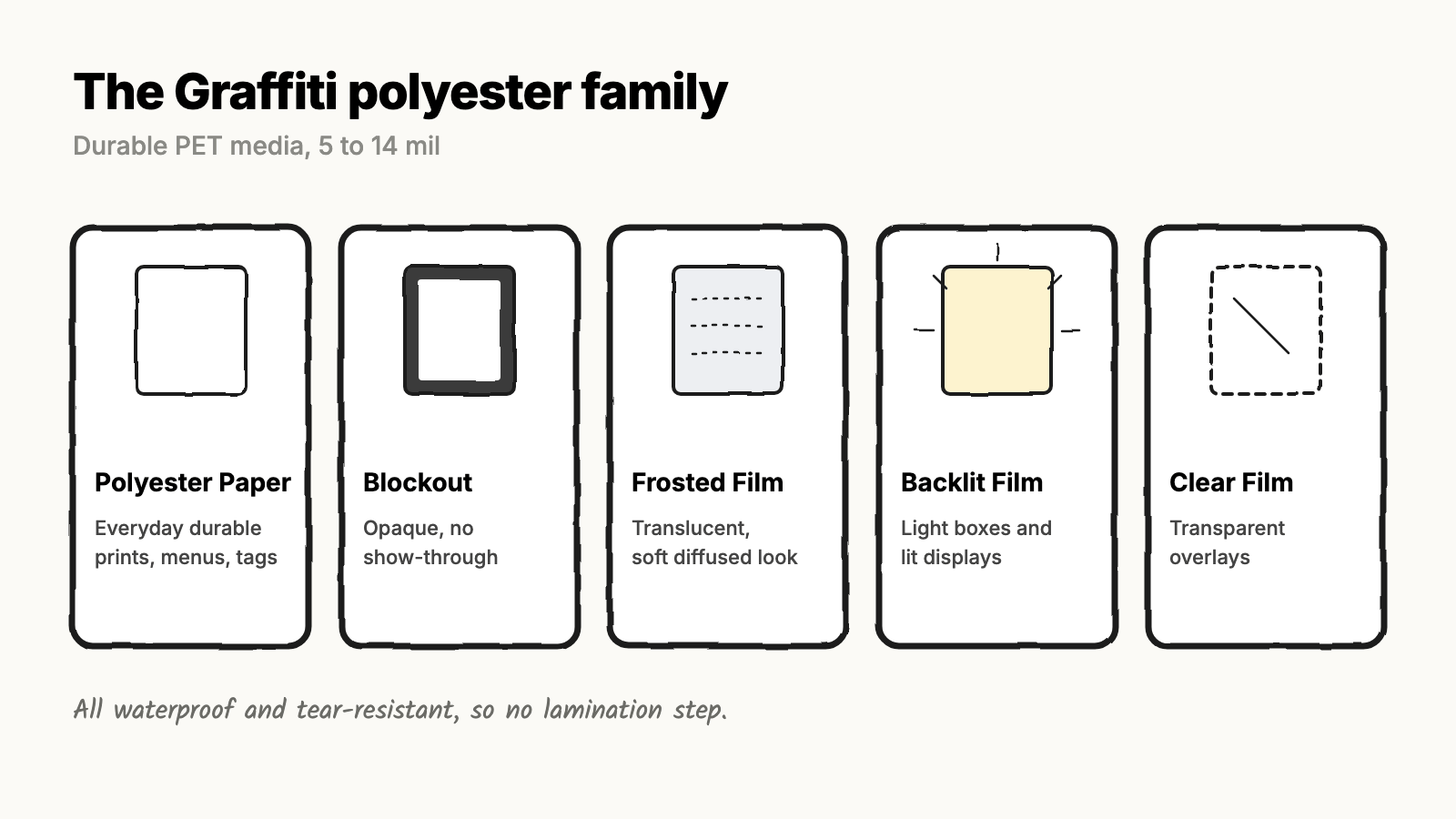
As an established rigid polyester paper supplier, 4S Graphics delivers the Graffiti line of premium substrates, engineered specifically for high-performance industrial environments. This range isn't merely a durable alternative to paper; it's a technical solution designed to maximize machine uptime while providing superior archival quality. By focusing on the material's physical capabilities, we ensure that every sheet maintains its structural integrity from the fuser to the final application. Our commitment to utilitarian excellence means providing media that performs consistently across the world's leading digital press platforms.
The Graffiti inventory provides unrivaled versatility in thickness, catering to diverse industrial requirements. Our selection includes lightweight 5 mil and 8 mil sheets for high-traffic manuals, alongside heavy-duty 10 mil, 11 mil, and 14 mil options for rigid signage and ID cards. Beyond standard matte finishes, we offer specialty media designed for high-end graphic impact. This includes Pearl Gold, Pearl Silver, and Pearl Rose finishes, as well as Frosted and Backlit films. These materials allow operations to achieve sophisticated aesthetic results without compromising the waterproof and tear-proof properties required for industrial longevity.
The Graffiti Advantage: Scuff-Free and PCR-Ready
The core of the Graffiti range is a proprietary scuff-free coating technology that ensures high-fidelity imaging and vibrant color density. This coating facilitates immediate toner anchoring, which prevents the flaking or scratching often seen on inferior synthetic media. In alignment with the 2026 sustainability standards discussed previously, 4S Graphics has integrated 35% post-consumer recycled (PCR) content into its premium lines. This allows your operation to meet Extended Producer Responsibility requirements without any loss in thermal stability or tensile strength. We invite you to order a sample pack to test these specifications on your specific equipment.
Beyond Paper: A Full Suite of Printing Substrates
Consolidating your technical media sourcing with a single authoritative specialist streamlines procurement and ensures material compatibility across your entire production floor. While we are a primary rigid polyester paper supplier, our expertise extends to a comprehensive suite of industrial substrates. This includes high-performance DTF transfer film, polyester laser plates, and durable label papers. By centralizing your sourcing with 4S Graphics, you gain access to consistent technical support and ICC profiling for your entire inventory. Explore the full range of rigid polyester papers at 4S Graphics.
Optimizing Industrial Print Performance for 2026
Transitioning to rigid polyester is a strategic move for operations looking to reduce production steps while increasing long-term durability. The technical shift toward PET ensures thermal stability and scuff-free results that traditional lamination simply can't match. As 2026 regulations prioritize sustainable materials, selecting a rigid polyester paper supplier that offers PCR-ready substrates is essential for maintaining compliance without sacrificing material strength. It's about securing a supply chain that values functional excellence as much as environmental responsibility.
4S Graphics provides the specialized engineering required for modern digital presses. Our Graffiti range is fully compatible with Xerox, Ricoh, Konica, and Fuji equipment, ensuring zero-flake toner adhesion across high-speed runs. Featuring 35% Post-Consumer Recycled (PCR) content and a thickness range spanning from 5mil to 14mil, we provide the specific calipers needed for every industrial application from field manuals to rigid signage. Secure your operational efficiency with substrates built for the most demanding environments.
Browse Our Rigid Polyester Paper Collection
Frequently Asked Questions
Is rigid polyester paper recyclable?
Rigid polyester is classified as a #1 plastic (PET), making it more widely recyclable than other synthetics. Many industrial recycling programs accept PET because of its high recovery value. As a leading rigid polyester paper supplier, we also offer versions containing 35% post-consumer recycled content to help businesses meet state-level sustainability mandates. This allows for a circular material lifecycle without compromising the substrate's high-performance characteristics.
Can I use rigid polyester paper in a standard desktop inkjet printer?
Rigid polyester paper is not compatible with standard aqueous inkjet printers. Because the PET substrate is non-porous, water-based inks cannot penetrate the surface, resulting in smearing and long dry times. This media is engineered specifically for dry toner digital presses and high-heat laser printers. These machines use a fusion process to bond toner particles to the specialized scuff-free coating on the sheet's surface.
What is the difference between mil and gsm in synthetic paper?
Mil refers to the physical thickness of the sheet, where 1 mil equals 1/1000 of an inch. GSM (grams per square meter) measures the weight of the material. In the synthetic paper industry, mil is the primary unit of measurement because different polymers have varying densities. While two sheets might share the same GSM, their stiffness and "snap" will differ based on their mil thickness or caliper.
Does rigid polyester paper require special ink or toner?
No specialized toner is required, but the substrate must be printed on equipment capable of high-heat fusion. Rigid polyester is designed to work with standard dry toner found in commercial presses like Xerox and Ricoh. The critical factor is the sheet's top-coating, which anchors the toner to prevent flaking. Your rigid polyester paper supplier should provide media that's specifically certified for your printer's thermal output and engine speed.
Can rigid polyester paper be written on with a pen or pencil?
You can write on rigid polyester paper using permanent markers or standard ballpoint pens. Because the surface is non-porous and scuff-resistant, graphite from pencils won't adhere well, and water-based felt tips may bead or smear. For industrial applications like warehouse tags or field logs, permanent solvent-based markers provide the best results. The writing remains waterproof and legible even when exposed to harsh environmental conditions.
How does rigid polyester paper handle extreme temperatures?
Rigid polyester is thermally stable at temperatures ranging from sub-zero to 435°F. This high melting point prevents the substrate from warping or shrinking during the high-heat fusion process of digital printing. Unlike polypropylene or PVC, PET won't become brittle in freezing outdoor environments. This temperature resilience makes it the industrial standard for signage in cold storage or labels on machinery that generates significant heat.
What is the best caliper for a restaurant menu?
A 10mil or 14mil thickness is the industry standard for restaurant menus. The 10mil caliper offers a balanced, flexible feel that's easy for patrons to handle, while 14mil provides maximum rigidity comparable to a heavy cardstock. Both options eliminate the need for lamination. These thicknesses ensure the menu stays flat on the table and resists the "dog-earing" common with thinner synthetic films.
Is rigid polyester paper BPA-free and safe for food contact?
Yes, rigid polyester paper is BPA-free and safe for incidental food contact. The material is chemically inert and complies with FDA regulation 21 CFR 177.2420, establishing it as a safe medium for hospitality and food packaging applications. It doesn't leach chemicals or absorb organic oils, ensuring that menus and food tags remain hygienic throughout their service life even after repeated sanitization with industrial cleaners.
Shop the products in this guide
- Graffiti Polyester Paper
- Graffiti Blockout Polyester
- Graffiti Polyester Frosted Film
- Graffiti Polyester Backlit Film
- Graffiti Clear Film
- Polyester Grade synthetic papers