

Three numbers, two different questions
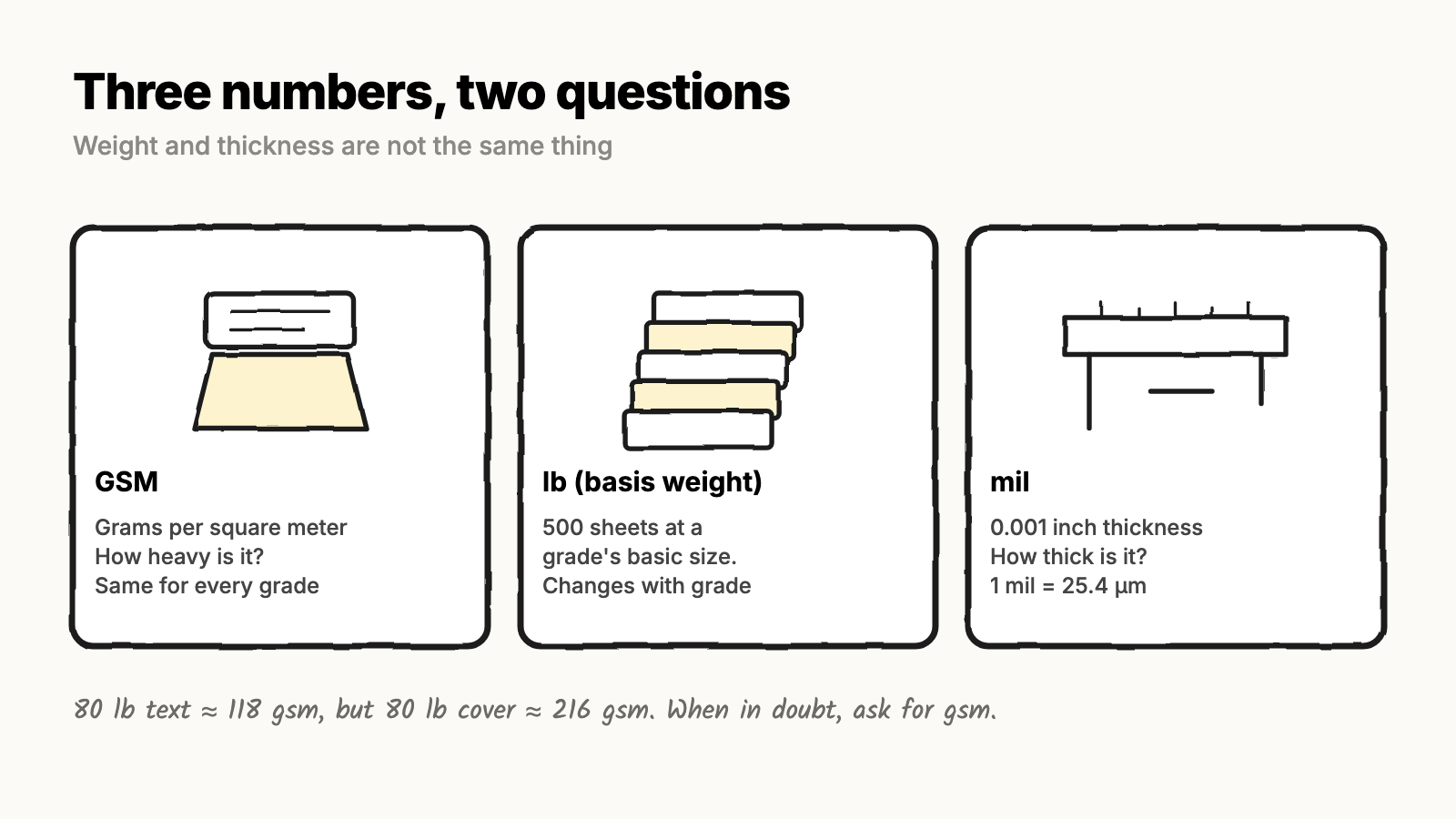
| Unit | Measures | Question it answers |
|---|---|---|
| GSM (grams per square meter) | Weight per area | "How heavy is it?" |
| lb (basis weight) | Weight of 500 sheets at a grade's basic size | "How heavy is it, in a system that depends on paper grade?" |
| mil (0.001 in = 25.4 µm) | Thickness (caliper) | "How thick is it?" |
Weight and thickness are not the same thing. A dense coated sheet and a fluffy uncoated sheet can weigh the same and measure differently.
Why pounds are confusing
US "basis weight" is the weight of a 500-sheet ream cut to a basic size that depends on the paper grade. Different grades, different basic sizes, so the same pound number means different things.
| Grade | Basic size (in) | 1 lb = ... gsm |
|---|---|---|
| Bond / writing | 17 × 22 | ≈ 3.76 |
| Text / book | 25 × 38 | ≈ 1.48 |
| Cover | 20 × 26 | ≈ 2.70 |
| Index | 25.5 × 30.5 | ≈ 1.81 |
So:
20 lb bond ≈ 75 gsm (office paper)
80 lb text ≈ 118 gsm
80 lb cover ≈ 216 gsm
100 lb cover ≈ 270 gsm
"80 lb" can mean 118 gsm or 216 gsm. Always ask which grade, or just use gsm.
The formulas
gsm = lb × grade factor (table above)
gsm → lb: divide by the factor
Canvas and fabric in ounces: oz/yd² × 33.9 = gsm
Mil → micron: mil × 25.4; micron → mil: divide by 25.4
Thickness is its own spec
Caliper is measured directly and doesn't convert from weight. Two things to know:
Same gsm, different caliper. Cotton-rag fine art papers, coated photo papers and film-based papers pack different amounts of material into the same weight. The spec sheet number is the only reliable answer.
Film and synthetic materials are normally sold by thickness (mil or micron), not basis weight, because they're not made from fibers. Don't try to compare "10 mil film" to "250 gsm paper" by feel.
Where thickness matters in practice:
Printer feed path. Many desktop and wide-format printers list a maximum media thickness. Heavy fine art stock may need a straight-through path.
Handling and framing. Thicker stock resists curling and feels like a gallery sheet.
Folding, scoring and cutting. Heavy stock cracks on the fold without scoring.
Quick cheat sheet
| What they say | What they likely need |
|---|---|
| "Like regular office paper" | ~75–90 gsm |
| "Like a nice brochure" | ~150–170 gsm |
| "Like a postcard or business card" | ~270–350 gsm |
| "Like a gallery print" | Usually ~250–350 gsm, plus a surface type (matte, baryta-style, textured) |
Shop the products in this guide
- Photo & Fine Art Papers
- CLiQ Fine Art & Photo Paper swatch book
- Digital Synthetic Papers
- Fabric Print Canvas