By the end of 2026, the global market for tree free synthetic paper is projected to reach $1.06 billion, reflecting a massive shift away from fragile, wood-pulp materials. You've likely faced the frustration of printed assets that fail in high-traffic environments, whether it's moisture-damaged signage or industrial labels that tear under stress. As environmental regulations like the EU Deforestation Regulation (EUDR) and the Packaging and Packaging Waste Regulation (PPWR) take full effect this year, the search for a durable, compliant alternative has become a business necessity.
We understand that material performance is non-negotiable for commercial printing. This 2026 guide explores the technical advantages of these specialized substrates, engineered to be 100% waterproof and virtually indestructible. You'll learn how these media meet modern sustainability benchmarks without compromising on print quality or longevity. We'll break down the material science behind high-performance substrates and identify how to source reliable, professional-grade media for your most demanding industrial applications.
Key Takeaways
Distinguish between Polypropylene and Polyester bases to ensure your substrate choice matches the specific durability requirements of your project.
Learn why tree free synthetic paper has become the industry standard for 2026 sustainability compliance and ESG reporting.
Identify high-performance applications where 100% waterproof and tear-resistant media eliminate the common failure points of traditional wood-pulp paper.
Explore the lifecycle benefits of synthetic extrusion, including its superior resilience and reduced environmental impact compared to pulp processing.
insights into sourcing professional-grade media like rigid polyester paper from specialized suppliers to solve complex industrial printing challenges.
What is Tree-Free Synthetic Paper? Defining the 2026 Standards
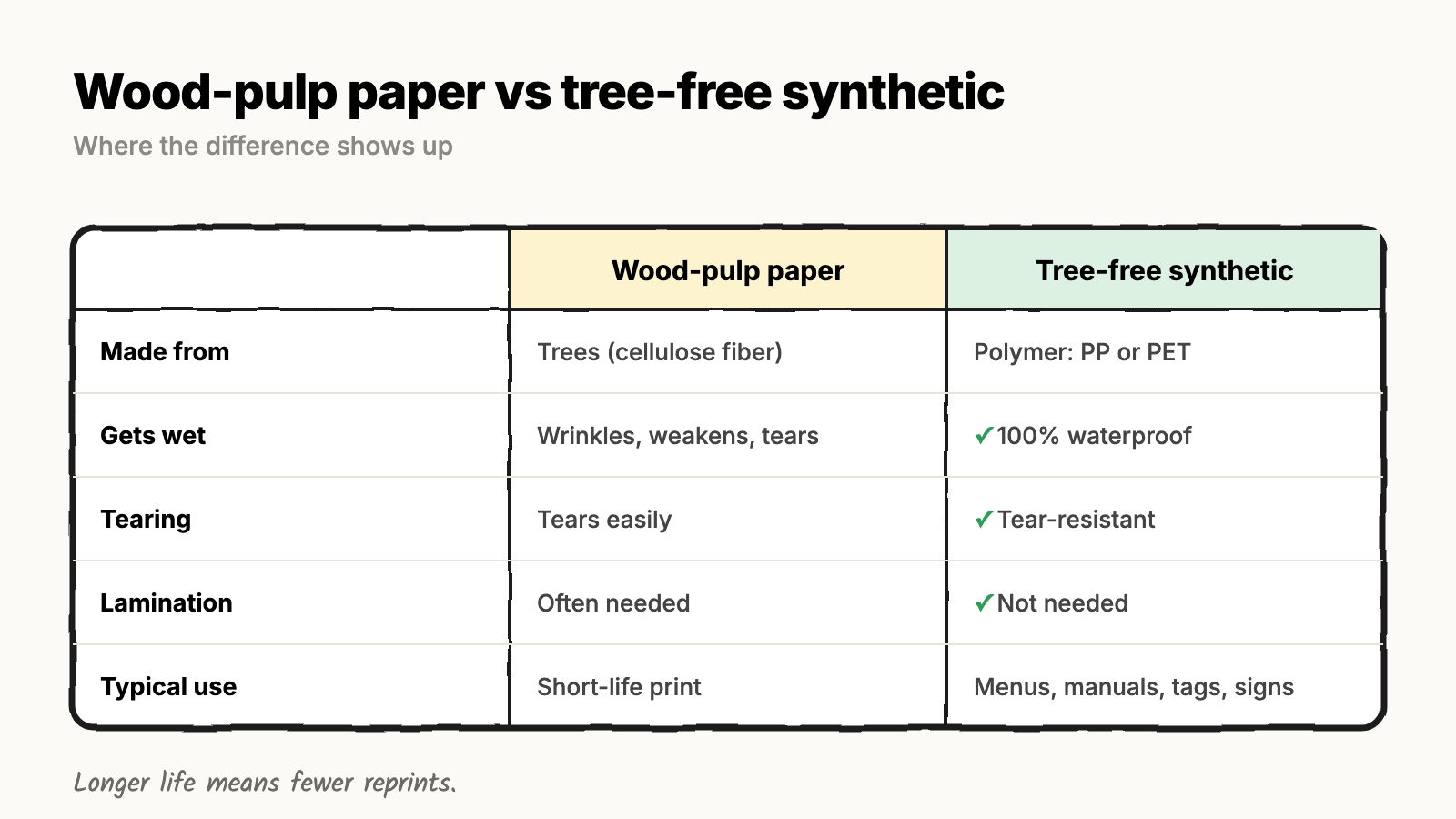
Synthetic paper is a high-performance printing substrate manufactured from synthetic resins, primarily Biaxially Oriented Polypropylene (BOPP) or High-Density Polyethylene (HDPE). Unlike traditional paper, it contains no organic wood fibers or pulp. This distinction is vital for 2026 Environmental, Social, and Governance (ESG) reporting. As the European Union Deforestation Regulation (EUDR) takes effect, businesses are increasingly adopting tree free synthetic paper to simplify compliance and ensure their supply chains are entirely deforestation-free. These materials allow organizations to meet strict sustainability standards without the administrative burden of tracing wood-pulp origins.
The manufacturing process begins with high-grade plastic resins that are melted and extruded into a continuous film. This film is then stretched in multiple directions to enhance its tensile strength and dimensional stability. This extrusion process creates a non-porous, solid surface that is naturally impervious to liquids. Traditional wood-pulp paper relies on a network of interlocking fibers that absorb moisture, oils, and chemicals. This absorption leads to structural degradation, swelling, and ink blurring in demanding environments. Synthetic media eliminates these failure points by providing a stable, non-absorbent foundation that maintains its integrity under extreme conditions.
The Evolution of Non-Pulp Substrates
Historically, synthetic media was a niche product used for specialized industrial tags or outdoor signage. Early versions were often rigid and difficult to fold, limiting their application. By June 2026, advancements in surface coating technology and multi-layer extrusion have transformed the tactile experience. Modern substrates now offer a "soft-touch" finish and superior foldability that rivals premium matte paper. This technical progress has allowed these materials to move into mainstream commercial use, becoming the standard for high-traffic menus, field manuals, and durable marketing assets.
Key Attributes of Professional Synthetic Media
Professional substrates are categorized by their polymer base, which dictates their performance in specific environments. Polypropylene (PP) is the most common base for general commercial printing due to its versatility and cost-efficiency. Polyester (PET) is preferred for applications requiring extreme heat resistance or archival longevity. In the printing industry, "high-performance" is defined by the substrate's ability to resist UV degradation, chemical exposure, and mechanical stress without losing print fidelity.
Waterproof Integrity: The material does not delaminate or warp when submerged.
Tear Resistance: High tensile strength prevents accidental ripping in high-traffic use.
Chemical Resilience: The surface resists damage from oils, alcohols, and cleaning agents.
Tree-free synthetic paper is a 100% polymer-based substrate engineered with zero-pulp content to provide absolute water resistance and tear strength in industrial environments.
Material Science: Polypropylene vs. Polyester Bases
Selecting a high-performance substrate requires a deep understanding of the base polymer. While the market for tree free synthetic paper continues to grow at a projected CAGR of 8.7% through 2034, the choice between Polypropylene and Polyester remains the most critical technical decision. These materials aren't interchangeable. Each polymer offers distinct thermal properties and mechanical strengths that dictate its suitability for specific printing processes and end-use environments. Professional printers must evaluate these chemical foundations to ensure the finished product survives its intended application.
Polypropylene (PP): The Versatile Workhorse
Polypropylene is currently the largest segment of the synthetic paper market. It's prized for its flexibility and exceptional fold-endurance, making it the ideal choice for field maps, instructional manuals, and high-traffic menus that must withstand repeated handling. Its lower specific gravity allows manufacturers to produce a substrate that feels like traditional paper but remains lightweight and highly opaque. Biaxially oriented polypropylene (BOPP) technology further enhances this by stretching the film in two directions, providing balanced strength and a smooth surface for high-fidelity graphics.
Flexibility: Resists cracking or delaminating even after thousands of folds.
Cost-Efficiency: Optimized for high-volume commercial applications where budget and performance must balance.
Opacity: Achieving a professional, paper-like appearance without the use of wood fibers.
Polyester (PET): For Extreme Durability
Polyester bases are engineered for environments where Polypropylene might fail. The primary advantage of PET is its dimensional stability under high heat. While PP may warp or shrink at temperatures above 200°F, rigid polyester paper remains stable. This makes it the preferred choice for laser toner printers and high-speed digital presses that utilize intense fuser heat. PET also offers superior tear-strength metrics, providing the highest mechanical resistance against puncturing and edge-tearing in industrial settings.
Thermal Resistance: Compatible with dry toner fuser units without losing registration or shape.
Archival Quality: Provides long-term stability for documents that must remain legible for decades.
Industrial Applications: Ideal for heavy-duty tagging, weatherproof ID cards, and chemical-resistant labels.
Surface tension is the final piece of the material science puzzle. Because these polymers are non-absorbent, they require specialized topcoats to ensure ink adhesion. Professional-grade substrates are treated to achieve specific dyne levels, facilitating a strong bond with UV, latex, or toner-based inks. If you're unsure which base material fits your specific press, reviewing a full range of synthetic papers can help identify the correct technical specifications for your equipment. This technical precision ensures that your prints don't just look good on the press but remain durable throughout their entire lifecycle.
2026 Trends: Sustainability and the Circular Economy
The regulatory landscape of 2026 is fundamentally reshaping substrate selection for global commercial print shops. With the European Union Deforestation Regulation (EUDR) requiring rigorous proof of deforestation-free supply chains by the end of this year, many organizations are pivoting toward tree free synthetic paper to eliminate the administrative burden of wood-pulp tracing. This shift is particularly evident in high-traffic commercial applications where traditional paper's limited lifespan creates a cycle of constant reprinting and waste. By adopting durable synthetic media, businesses can align their procurement with the 2026 corporate Net Zero goals that demand measurable reductions in operational waste.
A Life Cycle Assessment (LCA) reveals significant environmental advantages for synthetic substrates over traditional pulp. The manufacturing of wood-pulp is an exceptionally water-intensive process, often requiring thousands of gallons of water per ton of finished material. Synthetic extrusion processes consume a fraction of that amount, making them a technologically superior choice for production facilities in water-scarce regions. Modern print shops are also re-evaluating their waste streams to meet new standards like California's SB 343 and Colorado's Extended Producer Responsibility (EPR) program, which both went into full effect in 2026. These regulations prioritize materials that have clear, established pathways for end-of-life management.
Reducing the Environmental Footprint
Water conservation is only one part of the technical advantage. Traditional paper manufacturing relies on aggressive bleaching chemicals, such as chlorine, to achieve high brightness levels. Synthetic media is naturally white and opaque, removing these hazardous chemicals from the production cycle entirely. This reduction in chemical runoff simplifies compliance with increasingly strict industrial discharge permits. Tree-free synthetic paper contributes to the circular economy through its 100% recyclability in Category 5 plastic streams.
Sustainability as a Performance Metric
In a professional B2B context, longevity is the ultimate sustainability metric. A waterproof, tear-resistant manual or industrial tag that lasts for years is inherently more sustainable than a wood-pulp equivalent that requires monthly replacement. This "durability-first" approach reduces the total volume of material consumed over a project's lifecycle. We're also seeing a rapid move toward "monomaterial" packaging and labeling. By using a single polymer type for both the container and the label, facilities can significantly increase the efficiency of automated recycling systems. 4S Graphics supports these sustainable procurement initiatives by providing a reliable inventory of specialized substrates that meet current global recyclability standards.
Industrial Applications and Printing Compatibility
Modern industrial environments demand substrates that remain functional under extreme physical and chemical stress. While traditional wood-pulp paper fails when exposed to moisture or grease, tree free synthetic paper maintains its structural integrity and legibility. This resilience makes it the primary choice for submersible applications like scuba diving logs and underwater signage. In these scenarios, the material's non-porous nature prevents the delamination and ink bleeding that typically occur in saturated conditions. Beyond marine use, the high tensile strength of these media is essential for military field guides and high-traffic municipal maps that must survive repeated handling in outdoor environments.
Chemical and oil resistance is another critical performance metric for industrial labeling. Automotive manuals and workshop guides often come into contact with solvents, lubricants, and cleaning agents. A polymer-based substrate ensures that important safety information remains readable even after accidental exposure to harsh chemicals. To achieve these results, professional printers must select the correct printing method for the specific substrate. Most synthetic media are compatible with several high-output processes:
Offset Printing: Requires oxidizing inks or UV-cured systems to ensure proper drying on the non-absorbent surface.
Screen Printing: Ideal for outdoor signage requiring heavy ink deposits and high UV resistance.
Flexography: The industry standard for high-speed production of durable label papers used in global logistics.
Digital Printing: Includes both UV inkjet and dry toner laser systems, provided the substrate is thermally stabilized.
Optimizing for Digital and Offset Presses
Printing on synthetic media requires specific technical adjustments to maintain registration and print quality. Static electricity is a common challenge in high-speed feeders; professional substrates often include anti-static treatments to prevent misfeeds. Because the surface is non-absorbent, drying times are significantly longer than traditional paper unless UV-cured inks are used. For high-heat digital environments, rigid polyester paper is the necessary benchmark. Its thermal stability prevents the substrate from warping or shrinking as it passes through the high-temperature fuser units of a laser press.
Specialized Use Cases in 2026
The year 2026 has seen the standardization of synthetic media across several specialized sectors. In horticulture, weatherproof tags must withstand constant irrigation and extreme UV exposure without becoming brittle. The hospitality industry has largely adopted the "waterproof menu" standard, where high-end restaurants use durable substrates that can be sanitized repeatedly without damage. Additionally, global logistics providers now rely on specialized media for supply chain tracking, ensuring that labels remain intact from sub-zero shipping containers to humid tropical ports. If your project requires high-performance media, explore our full range of synthetic papers to find the exact match for your press and application.
Sourcing Professional Synthetic Substrates from 4S Graphics
Sourcing tree free synthetic paper requires more than a simple transaction. It demands a partnership with a supplier that understands the chemical interactions between specialized coatings and complex ink systems. 4S Graphics operates as an authoritative specialist in the field, providing the technical expertise necessary to navigate the challenges of non-absorbent printing. Our consultative approach ensures that every substrate matches the specific thermal and mechanical requirements of your hardware, preventing costly press downtime or material failure. We don't just provide media; we provide engineered solutions for the most demanding industrial environments.
Our inventory is built for resilience and professional-grade performance. We maintain a robust selection of media, ranging from rigid polyester paper for high-heat digital environments to durable label papers designed for logistical tracking. With an established distribution network across North and South America, we provide efficient access to high-performance substrates. We offer same-day shipping for in-stock products, ensuring that your production schedule remains uninterrupted. This logistical efficiency is paired with a deep catalog that includes everything from fine art papers to polyester laser plates, making us a comprehensive source for specialized printing needs.
The 4S Graphics Quality Standard
Every material in our catalog undergoes rigorous testing to meet industrial standards. We evaluate critical metrics such as tear strength, dimensional stability, and ink adhesion across various production runs. This ensures consistent opacity and brightness, which are vital for high-fidelity color reproduction and brand consistency. Our support extends to modern printing technologies, including DTF transfer film and specialized screen printing positives. By maintaining these high standards, we help print shops deliver results that remain stable under UV exposure, mechanical stress, and chemical contact.
Partnering for High-Durability Projects
Success in high-durability projects starts with technical verification. We encourage a methodical approach to material selection. Professionals can request samples for internal testing to confirm compatibility with their specific ink sets and environmental conditions. To accommodate specialized press requirements, we provide custom slit and sheet sizes, ensuring the material integrates seamlessly into your existing workflow. Whether you're producing waterproof menus or industrial-grade safety signage, our team provides the technical data needed to make an informed procurement decision.
Explore our full range of high-durability synthetic papers at 4S Graphics
Future-Proofing Commercial Print with Advanced Substrates
Transitioning to tree free synthetic paper is a strategic move that aligns your production with 2026 sustainability standards while providing unmatched material resilience. You've seen how the distinction between Polypropylene and Polyester bases determines the success of your application, especially when dealing with high-heat digital environments or chemical exposure. Choosing a substrate that is 100% waterproof and tear-resistant doesn't just solve immediate durability issues; it reduces long-term waste by extending the lifecycle of every printed piece.
As an authoritative specialist in high-performance media, 4S Graphics provides the technical expertise and global distribution capabilities your commercial print shop requires. We focus on the physical capabilities of the substrate to ensure it meets your specific printing challenges without compromise. It's time to elevate your material standards and future-proof your inventory. Investing in professional-grade media today guarantees the longevity and compliance of your print operations tomorrow.
Browse Professional Synthetic Paper and Rigid Polyester Substrates and secure the reliability your industrial projects deserve.
Frequently Asked Questions
Is tree-free synthetic paper actually eco-friendly if it is made of plastic?
Yes, it is considered a sustainable alternative because it eliminates the environmental impact of deforestation and consumes significantly less water than pulp manufacturing. By removing the need for lamination, it also reduces the total volume of material used in durable applications. This simplifies compliance with 2026 regulations like the EU Deforestation Regulation (EUDR) for businesses tracking their environmental footprint.
Can I print on synthetic paper with a standard home inkjet printer?
No, standard home inkjet printers are generally incompatible with these substrates because their water-based inks cannot penetrate the non-porous plastic surface. Professional printing requires specialized coatings or the use of UV-cured, latex, or solvent-based inks. Without these specific technologies, the ink will remain wet on the surface and smear immediately upon contact.
How does the cost of synthetic paper compare to traditional wood-pulp paper?
Synthetic substrates typically have a higher initial acquisition cost per sheet compared to standard wood-pulp paper. However, they provide a lower total cost of ownership by eliminating secondary processes like lamination and preventing frequent reprinting of damaged materials. In high-traffic or industrial environments, the longevity of the material makes it a more cost-efficient long-term investment.
Is tree-free synthetic paper recyclable in standard curbside bins?
No, tree free synthetic paper is not compatible with the recycling streams used for traditional wood-pulp products. It must be processed through industrial plastic recycling channels, specifically Category 5 for Polypropylene or Category 1 for Polyester. Mixing these materials with regular paper can contaminate the pulp stream and reduce the quality of the recycled output.
What is the best type of synthetic paper for outdoor signage in 2026?
Biaxially Oriented Polypropylene (BOPP) remains the industry standard for outdoor signage due to its exceptional UV stability and resistance to environmental moisture. It maintains high opacity and structural integrity even when exposed to direct sunlight and fluctuating temperatures. This material is particularly effective for large-format displays that require high-fidelity graphics and long-term durability in external environments.
Does synthetic paper yellow or degrade over time like traditional paper?
No, synthetic substrates do not contain lignin, which is the organic compound in wood-pulp that causes yellowing and brittleness when exposed to light and oxygen. This chemical stability makes them an ideal choice for archival documents, safety manuals, and industrial tags that must remain legible for years. They are naturally resistant to the environmental factors that typically degrade organic paper fibers.
What is the difference between polypropylene and rigid polyester paper?
The primary distinction is thermal resistance and mechanical rigidity. Polypropylene is a flexible, cost-effective material suitable for folding applications like maps and menus. Rigid polyester paper offers superior dimensional stability and heat resistance, which is necessary for the high-temperature fuser units found in dry toner laser presses. Polyester is also more resistant to puncturing and high-tensile stress.
Can synthetic paper be folded and finished like regular paper?
Yes, these substrates can be folded, die-cut, and perforated using standard finishing equipment, though technical adjustments are often required. Because the material is denser than wood-pulp, printers must use sharper blades and adjusted scoring depths to ensure clean edges and precise folds. Modern multi-layer extrusion allows these media to maintain a professional "dead-fold" similar to high-quality traditional paper.
Shop the products in this guide
- Digital Synthetic Papers
- Polyester Grade synthetic papers
- Soft Poly synthetic papers
- Blended Poly synthetic papers
- Graffiti Polyester Paper