The one-minute version
Water-based inkjet ink is mostly liquid. The color (dye or pigment) is a small part of what leaves the nozzle. If that liquid has nowhere to go, it pools, beads, smears and bleeds. The coating is a sponge with rules: it takes the liquid in fast, and holds the color exactly where the printer put it.
Two kinds of ink-receiving coating
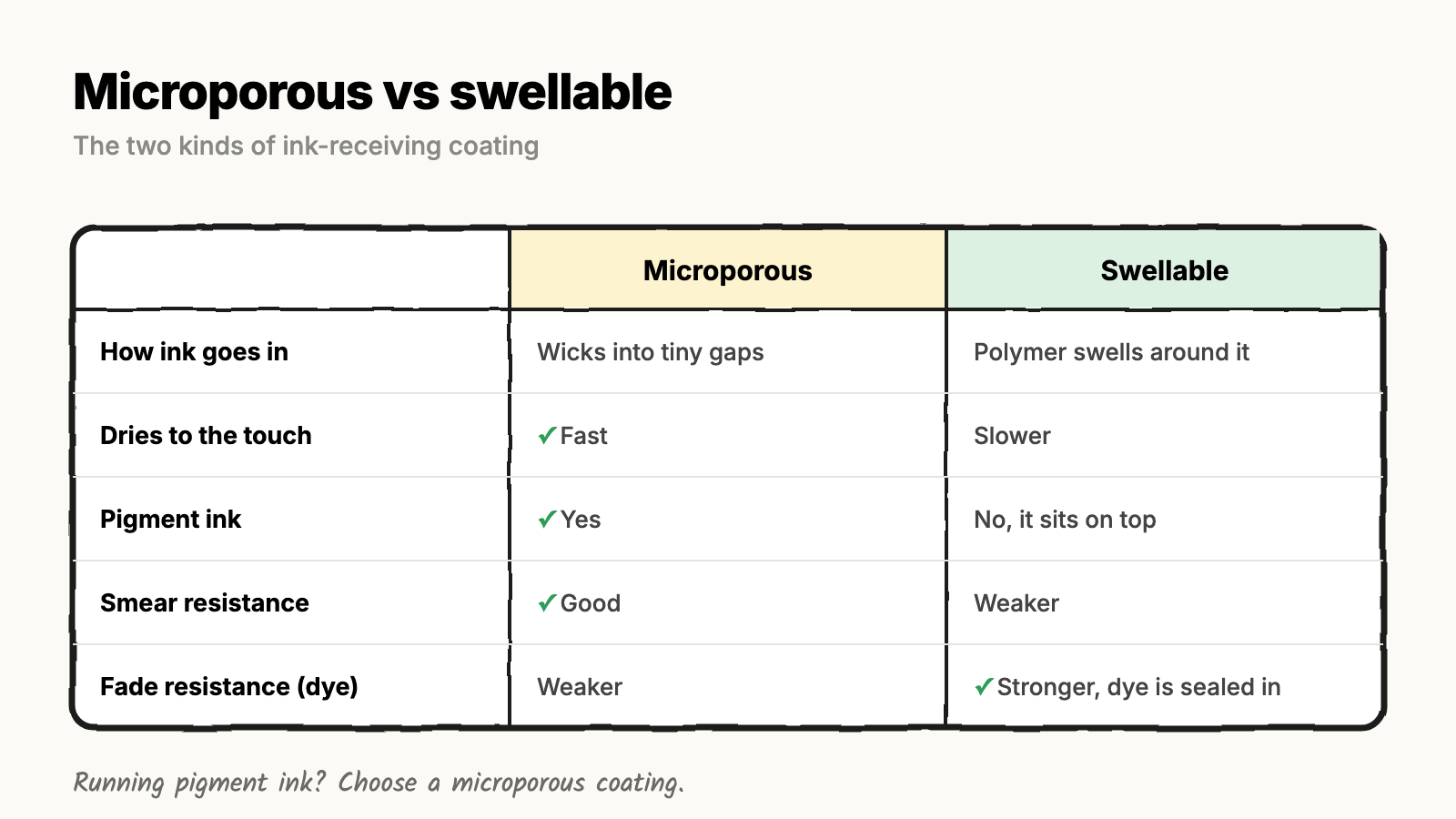
| Microporous | Swellable | |
|---|---|---|
| What it is | Silica or alumina particles held by a binder. Tiny gaps between particles. | A continuous polymer layer with no visible pores. |
| How ink goes in | Capillary action. The wicks into the gaps. | The polymer swells and takes the ink in. |
| Dries to the touch | Fast | Slower |
| Smear resistance | Good | Weaker |
| Works with dye ink | Yes | Yes |
| Works with pigment ink | Yes | No. Pigment particles are too big to enter, so they sit on top. |
| Light and air-fade (dye) | Weaker | Stronger. The dye is sealed inside. |
Why this matters: if you're running pigment ink, as most wide-format and screen-print film users are, you need a microporous coating. If you run dye ink and care about fade, swellable has the edge. Putting pigment ink on a swellable coating is the classic cause of smeared prints.
The film example, straight from our own FAQ
The eIe inkjet film is PET with a microporous coating on the front and an antistatic coating on the back. Our FAQ explains it well:
The coating isn't truly "waterproof." It's bleed resistant. A truly waterproof surface would repel water-based ink and the ink would bead up. The name stuck from before pigment inks became standard.
The vehicle (water plus glycol) soaks into the pores. The pigment particles stay at the surface, "like sprinkles on a frosted donut."
Dry to touch is not dry. Glycol humectants stay trapped in the coating. Heat on a freshly printed film makes the glycol flash to steam and form bubbles. Practical rules from the FAQ:
- Keep the room at 60–80°F (15–25°C) and 40–55% RH.
- Let the film dry about 24 hours before storing.
- Use a dry positive against a dry stencil, or the ink can transfer to the stencil under vacuum.
When you don't need a coating
| Ink type | How it attaches | Coated media needed? |
|---|---|---|
| Aqueous dye or pigment | Absorbed into the coating | Yes |
| Solvent / eco-solvent | Strong solvent ‘bites’ into the surface (vinyl, etc.). Eco-solvent is milder. | Eco-solvent: Yes, it needs a coating. Strong solvent: No, it works on uncoated vinyl. |
| UV curable | Cures instantly under UV light and sits on the surface | No, though some materials (glass, metal, certain plastics) may need a primer for adhesion |
| Latex | Heat-cured polymer film on the surface | Generally no on vinyl and banner |
Note the difference between the two kinds of coating:
Ink-receiving layer: absorbs and holds liquid. This is what the article is about.
Primer or adhesion promoter: helps cured ink grip a slick surface. It doesn't absorb anything.
The two are easy to confuse, especially with flatbed UV printing.
What goes wrong, and what it usually means
| Symptom | Likely cause |
|---|---|
| Ink beads up, smears | Wrong side up, or no receptive coating for that ink |
| Pigment ink looks muddy, rubs off | Swellable coating with pigment ink |
| Prints stick to stencil or to each other | Not fully dry, humidity too high |
| Bubbles when heated | Trapped vehicle, not fully dried |
| Positives too light for exposure | Not enough ink density. A RIP helps (more below). |
| Static, sheets jam or double-feed | Dry room, antistatic back side not facing the right way |
Screen-print film: the RIP point
From the FAQ: inkjet drivers are built for color on white paper. Screen printers need hard-edged, opaque black on clear film. A RIP lets you build ink density and control dot gain. Minimum 720 dpi for positives, 1440 dpi when time allows. Line art at 1200 dpi source, color or grayscale at 300 dpi or more.
Shop the products in this guide
- EiE (UV) Waterproof Inkjet Film (Rolls)
- EiE (UV) Waterproof Inkjet Film (Sheets)
- eLe Laser Film (Sheets)
- Screen Printing Positives
- Photo & Fine Art Papers
- Sign & Display Media