

What DTF is, in one paragraph
Direct-to-film printing prints a mirrored design onto coated PET film, dusts it with hot-melt adhesive powder, melts the powder, then heat-presses the design onto a garment and peels the film away. Because the design is made on film, not on the garment, it works on cotton, polyester, blends, dark fabrics and many other textiles without special pretreatment.
The film
DTF film is PET, like the screen-print film we sell, with a coating designed for two jobs:
Receive the ink (a receptive layer, same principle as our article on inkjet coatings).
Release the design during the peel (a release layer).
It comes as rolls (common widths include 12–13 in, 24 in and 60 cm) and sheets for desktop printers.
The process
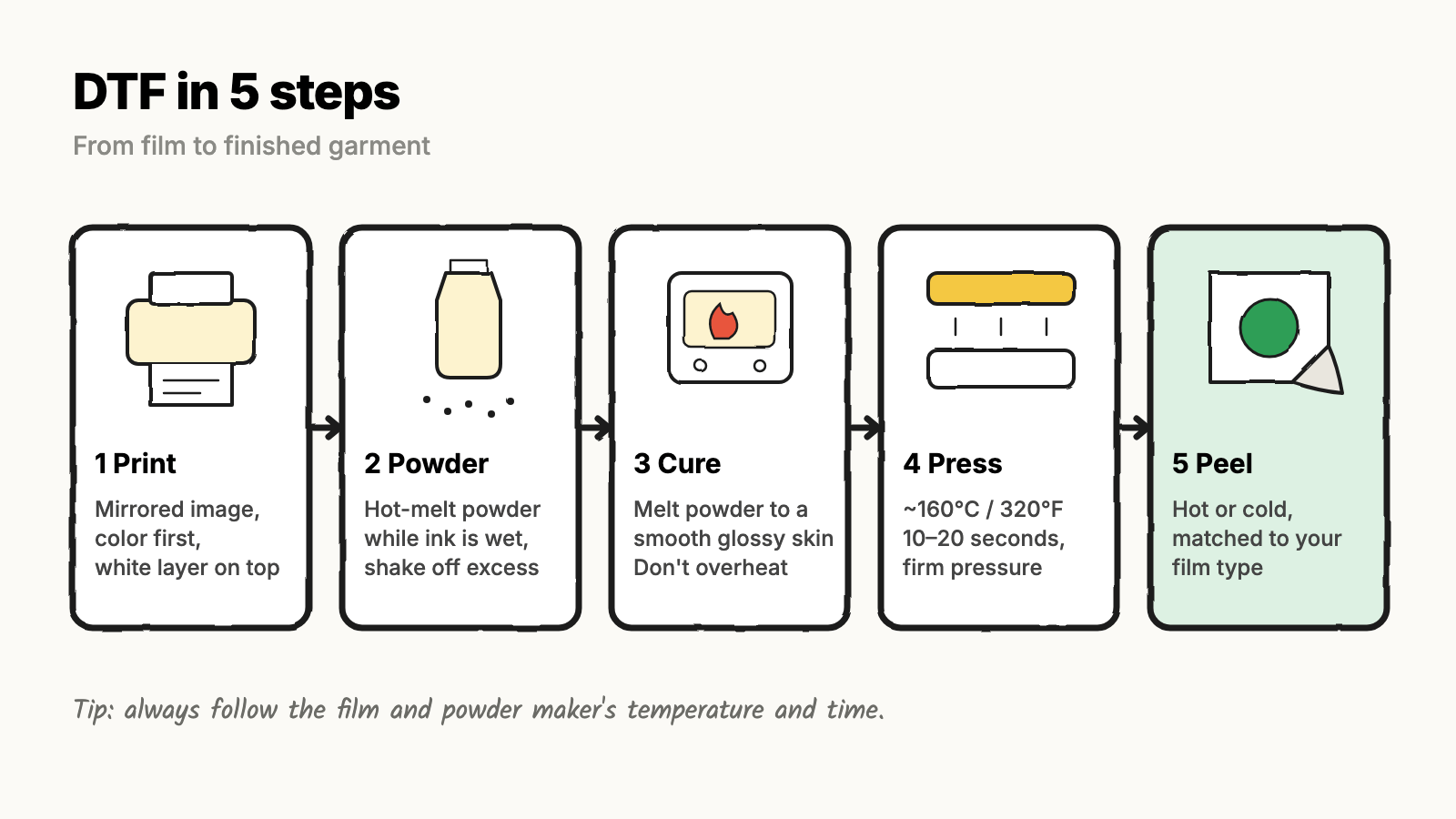
Print. Color layers (CMYK) go down first. A white layer goes over them so the colors sit on a white base. The image is mirrored, so it reads correctly after transfer.
Powder. While the ink is still wet, apply hot-melt adhesive . It sticks only to the ink. Shake off the excess.
Cure. Melt the powder until it's a smooth, glossy skin (oven, curing station or heat press). Don't overheat. Follow the powder maker's temperature and time.
Press. Film face-down on the garment. Typical press settings reported by suppliers are around 160°C / 320°F for 10–20 seconds with firm pressure.
Peel. Hot or cold, depending on the film (see below).
Optional finish press. A short second press with a cover sheet improves feel and bond. Check the film instructions.
Hot peel vs cold peel
| Hot peel | Cold peel | |
|---|---|---|
| When you peel | Right after pressing, while hot | After the transfer cools (about 30 seconds or more) |
| Speed | Faster, good for production | Slower |
| Look | Often glossier, vivid | Often more matte, with a textured feel |
| Detail | Good | Often described as crisper on fine detail |
| Risk | Peeling too cold gives a partial transfer | Peeling too early or too late can lift or smear |
The difference comes from the film's release coating. You must match the peel method to the film. Cold-peel film peeled hot (or the reverse) is a leading cause of poor transfers. Some films are sold as "universal hot/cold."
DTF vs the alternatives
| DTF | DTG | Sublimation | Screen print | |
|---|---|---|---|---|
| Fabric | Most fabrics | Mostly cotton-rich | Light polyester | Almost anything |
| Dark garments | Yes | Needs pretreatment | No | Yes |
| Short runs | Excellent | Excellent | Excellent | Poor (setup cost) |
| Long runs | Moderate | Slow | Moderate | Excellent |
| Hand feel | Soft but noticeable layer | Softest | Zero hand | Varies |
What goes wrong
| Symptom | Likely cause |
|---|---|
| Powder won't stick or falls off | Ink already dry before powdering, or too little powder |
| Powder sticks outside the design | Film touched or static, powder not shaken clean |
| Design won't release from the film | Wrong peel method, or press too cool or too short |
| Cracking after washing | Under-cured powder, low pressure, or wrong fabric settings |
| Faded or flat colors | White layer too thin or color/white order wrong |
| Ghosting, double edges | Film shifted during pressing |
| Poor white ink output | White ink settled. DTF printers need ink circulation and regular maintenance. |