

An "acid-free" label is no longer a sufficient guarantee of museum-grade longevity in a market where gas fading and substrate yellowing remain constant threats. Selecting the right archival fine art paper for inkjet requires looking past marketing buzzwords and into the material science of the substrate. Many professionals find that the gap between generic labels and actual chemical stability leads to inconsistent color reproduction and compromised prints. It's frustrating to invest in high-fidelity equipment only to have the final product fail because of environmental wear.
This guide provides the technical clarity needed to select high-performance media for professional reproductions. You'll master the archival standards necessary for true permanence, including the requirements set by the updated ISO 11108:2025 standard. We'll examine the chemistry of inkjet-receptive coatings, compare the structural benefits of cotton rag versus alpha-cellulose, and address the current discrepancies in international archival guidelines. This information ensures your work maintains its fidelity and value for decades.
Key Takeaways
Identify truly archival media by mastering the technical requirements for pH neutrality and the ISO 11108:2025 durability standards.
Evaluate the performance differences between 100% cotton rag and high-grade alpha-cellulose to select the most durable archival fine art paper for inkjet based on handling requirements.
Understand how specialized inkjet-receptive coatings control dot gain and ink bleed to ensure sharp, high-fidelity reproductions with a stable chemical bond.
Utilize GSM specifications and surface textures to align the physical properties of the substrate with specific artistic styles and presentation needs.
professional storage protocols and establish a technical supply chain to prevent environmental degradation and ensure long-term print stability.
Defining Archival Standards for Inkjet Fine Art Media
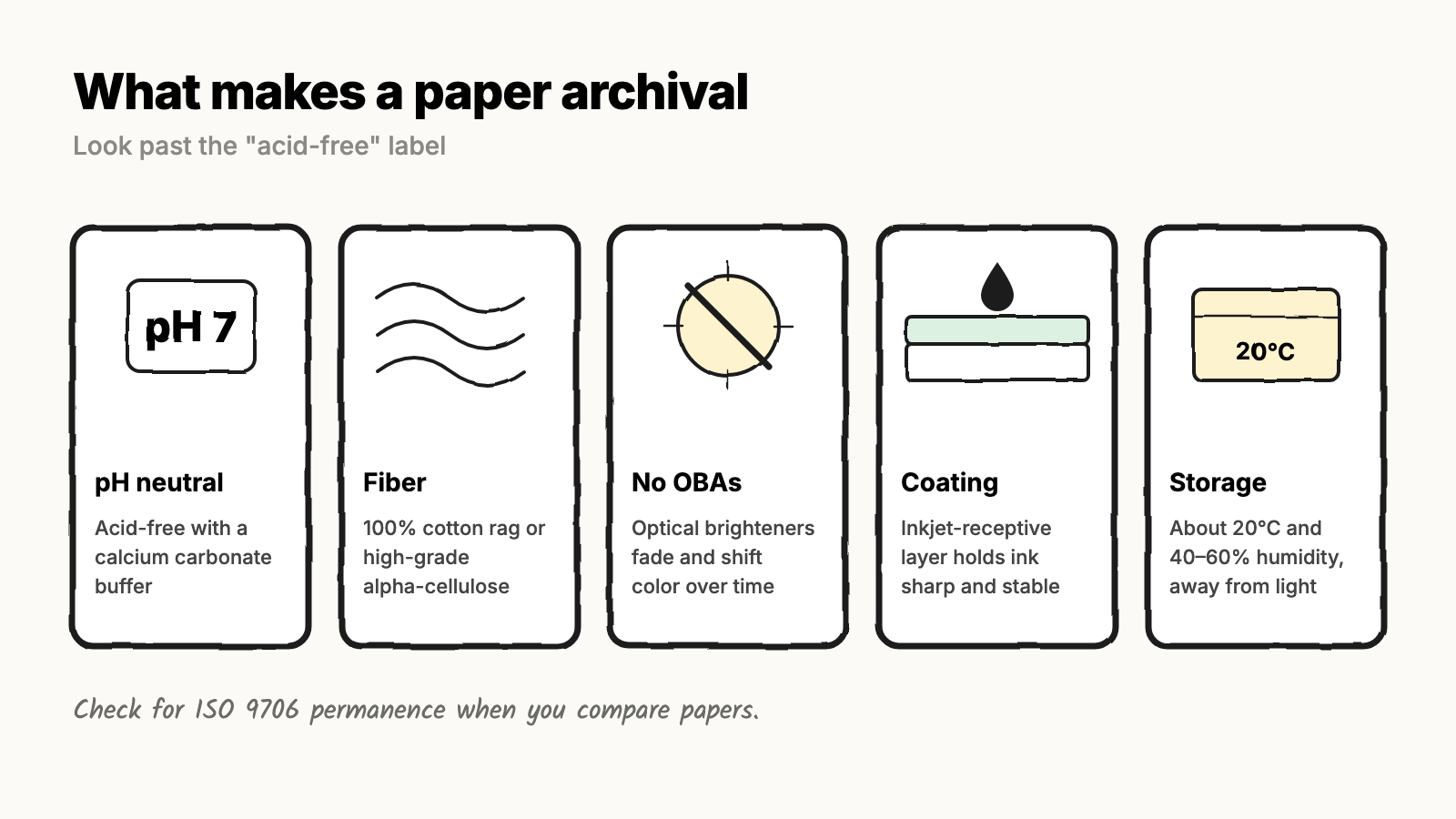
Archival inkjet paper is defined by its ability to resist chemical and physical deterioration for a period exceeding 100 years. Unlike standard photo papers that use resin-coated bases, museum-grade media focuses on the long-term stability of the substrate. This permanence is critical for fine art reproductions where the preservation of tonal range and structural integrity is non-negotiable. High-performance archival fine art paper for inkjet systems must withstand environmental stressors such as light exposure, humidity fluctuations, and atmospheric pollutants. It isn't just about the initial appearance; it's about the material's survival.
The primary differentiator between consumer-grade paper and professional media lies in the fiber source. Standard papers often contain lignin. Lignin is a natural polymer found in wood that oxidizes over time. This process makes paper yellow and brittle. Technical inkjet paper characteristics for archival use require the complete removal of lignin. By using purified alpha-cellulose or 100% cotton linters, manufacturers ensure the base material remains chemically inert. This purity prevents the "gas fading" and substrate degradation that typically plagues lower-quality prints within a few years of production.
The ISO 9706 Standard for Longevity
Professional print shops and galleries rely on the ISO 9706 certification to verify the permanence of their media. This international standard mandates specific chemical properties, including a high resistance to oxidation and a strict limit on easily oxidizable matter. To meet this standard, the paper must be manufactured with an alkaline reserve to neutralize atmospheric acids. Specifically, the alkaline reserve requirement must consist of at least 2% calcium carbonate. This chemical buffer ensures the paper maintains its pH balance throughout its lifecycle, protecting the image layer from internal acid migration. Without this buffer, even a pH-neutral paper can become acidic over time.
Acid-Free vs. Archival: Clearing the Confusion
The term "acid-free" is frequently used as a marketing baseline, but it doesn't always equate to archival quality. A paper can be acid-free at the point of manufacture through the use of surface treatments, yet still contain unstable wood pulp that will eventually acidify. Selecting archival fine art paper for inkjet requires looking beyond the initial pH level. Archival media implies a higher chemical standard where the entire substrate is composed of stable, high-purity fibers. Consumer brands often exploit this confusion. They label wood-based papers as "acid-free" to suggest a longevity they cannot physically deliver. True archival media remains stable because its core chemistry is designed for permanence, not just immediate performance.
Substrate Composition: Cotton Rag vs. Alpha-Cellulose
The physical foundation of archival fine art paper for inkjet determines both the longevity and the tactile quality of the finished print. Cotton rag, derived from cotton linters, remains the traditional choice for museum-grade work. Its naturally long fibers create a robust, flexible matrix that resists tearing and cracking during large-format handling. This structural integrity is essential for prints that will be mounted or rolled. The "hand" of a cotton-based paper is distinctive; it possesses a density and softness that collectors associate with high-value editions. Because cotton is naturally lignin-free, it requires less chemical processing to reach an archival state, maintaining the organic strength of the fiber.
High-grade alpha-cellulose fibers offer a compelling alternative for commercial galleries and high-volume production. While cotton is naturally stable, alpha-cellulose requires extensive chemical purification to remove unstable wood components. Once purified, these fibers are shorter than cotton, resulting in a smoother, more uniform surface. This uniformity often leads to superior ink holdout and edge sharpness, which is beneficial for detailed photographic work. For projects where cost-to-performance is a primary metric, alpha-cellulose provides archival stability at a more accessible price point without sacrificing the professional finish required for gallery exhibitions.
The Impact of Optical Brightening Agents (OBAs)
OBAs are fluorescent chemical compounds added to paper to increase perceived whiteness. They work by absorbing ultraviolet light and re-emitting it in the blue spectrum. While this creates a "whiter than white" appearance, it's a temporary effect. OBAs are chemically unstable; they dissipate over time. As these agents break down, the paper returns to its natural cream color, leading to perceived yellowing of the highlights. For museum-grade sales, selecting OBA-free archival fine art paper for inkjet is mandatory. This ensures the visual profile of the artwork remains unchanged for decades, protecting the artist's original intent from chemical degradation.
Alpha-Cellulose: The Modern Archival Alternative
Modern manufacturing has bridged the gap between wood-based substrates and traditional rag. Alpha-cellulose media is produced from wood pulp refined to contain more than 90% alpha-cellulose content. This level of purity ensures the substrate meets the same longevity standards as cotton rag. From an environmental perspective, wood-based substrates often have a lower footprint when sourced from FSC-certified forests. Wood is a renewable resource with lower water consumption requirements than industrial cotton production. Professionals requiring consistent material performance often turn to specialized fine art papers that balance these substrate characteristics with precision-engineered coatings.
The Chemistry of Inkjet Receptive Coatings
The receptive coating on an archival fine art paper for inkjet acts as the critical interface between the liquid ink and the solid substrate. It's a precision-engineered layer, not a simple surface finish. Its primary function is to manage the absorption of ink droplets to prevent dot gain and lateral bleed. By controlling these variables, the coating ensures that fine details remain sharp and tonal transitions stay smooth. The chemical bond between this coating and the base material must be exceptionally stable. If this bond fails, the print can suffer from delamination or surface flaking, especially in high-ink-load areas. Coating thickness also plays a direct role in defining the color gamut. A thicker, more absorbent layer allows for a higher volume of ink, which expands the chromatic range the media can reproduce.
Engineers design these coatings to work specifically with either aqueous pigment or dye-based inks. In the professional fine art sector, pigment ink compatibility is the priority due to its superior lightfastness. The coating must not only receive the ink but also fix it in place to ensure long-term stability. This requires a complex balance of binders and minerals that maintain their integrity under various environmental conditions. When the coating chemistry is optimized, the substrate can achieve a level of detail and color accuracy that is impossible on untreated papers.
Microporous vs. Swellable Coatings
Microporous coatings have become the industry standard for professional fine art printing. These coatings utilize sub-micron ceramic or silica particles to create a rigid, porous structure. This design allows pigment inks to dry almost instantly as the carrier fluid is wicked into the substrate while the pigment particles are trapped on the surface. In contrast, swellable coatings rely on polymer layers that expand to absorb ink. These are largely obsolete in the professional sector because they dry slowly and are highly sensitive to humidity. Microporous structures protect pigments from atmospheric pollutants by trapping them within a rigid mineral matrix, significantly extending the life of the print.
Achieving High Fidelity and Dmax
Maximum black density, or Dmax, is a vital metric for evaluating the quality of a fine art print. A high Dmax ensures deep, rich blacks that provide the necessary contrast for high-fidelity photography and digital art. Coating chemistry is specifically formulated to prevent "bronzing," where ink sits on the surface and creates an unnatural metallic sheen. It also eliminates differential gloss, ensuring a uniform finish across all ink densities. Professionals seeking to maximize their print depth should utilize high fidelity fine art paper to achieve the lowest possible black point. This level of control over the ink-to-media interaction is what separates museum-grade reproductions from standard commercial prints.
Selecting the Right Weight, Texture, and Finish
Physical specifications like weight and texture dictate the final presentation and durability of a print. GSM, or grams per square meter, serves as the primary metric for material density. A higher GSM value indicates a more robust substrate that resists cockling under heavy ink loads. When selecting archival fine art paper for inkjet, professionals must balance tactile quality with machine compatibility. The weight of the paper contributes to the "museum feel," providing a level of stiffness that makes the work suitable for high-end framing and archival mounting without the risk of creasing.
Surface texture fundamentally alters how light interacts with the image. Smooth finishes minimize light scatter, making them the superior choice for high-detail technical drawings or sharp, high-contrast photography. Conversely, textured or velvet finishes diffuse reflections, which reduces glare in brightly lit gallery spaces. This diffusion creates a sense of physical depth that enhances painterly reproductions but can soften the finest lines. A selection framework for these surfaces should be based on the subject matter. Portraits often require smooth matte or satin finishes to prevent paper grain from interfering with skin detail. Landscapes and abstract works benefit from cold-press or heavily textured surfaces that add a tactile dimension mimicking original canvases.
Weight and Thickness (Caliper)
A weight of 300+ GSM is the recognized industry standard for professional fine art prints. This density provides the necessary structural integrity for long-term preservation. Caliper, or the actual thickness of the sheet measured in mils or microns, directly impacts printer feed reliability. Heavy-weight archival media often requires the use of straight-path manual feed trays to avoid head strikes or mechanical jams. Handling precautions are mandatory for these substrates; always use cotton gloves or handle by the edges to prevent skin oils from contaminating the precision-engineered receptive coating before or after the printing process.
Surface Texture and Artistic Intent
The choice of texture should align with the original medium of the artwork to maintain fidelity. Smooth matte surfaces are the preferred choice for high-detail technical illustrations or architectural renderings where line precision is paramount. Cold-press textures are essential for watercolor reproductions, as the recessed areas of the paper catch the ink to simulate the look of traditional hand-painted works. Professionals looking for specific tactile responses can explore Canson fine art paper alternatives to find the exact grain required for their specific project needs.
Review our full inventory of Fine Art Papers to match your specific weight and texture requirements with professional-grade media.
Sourcing and Preserving Archival Media: The 4S Graphics Approach
Procuring archival fine art paper for inkjet systems through a technical supplier is a requirement for maintaining professional standards. General retailers often treat fine art media as standard office inventory, ignoring the specific environmental controls needed to prevent substrate degradation. 4S Graphics operates as an authoritative specialist, ensuring that every roll or sheet is stored and transported under conditions that preserve its chemical stability. We provide high-durability substrates engineered for museum-grade reproductions, bridging the gap between material science and the needs of professional print studios. For those exploring alternative mediums, the availability of professional print canvas rolls offers the same archival rigor in a textile format.
Preservation continues after the material leaves the warehouse. Best practices for archival storage include maintaining a consistent temperature of approximately 20°C and a relative humidity between 40% and 60%. Fluctuations outside these ranges can cause the fibers to expand or contract, leading to paper curl or coating failure. Prints should always be separated by acid-free interleaving tissue to prevent ink transfer or physical abrasion. These methodical steps protect the integrity of the receptive coating and the purity of the base fibers discussed in previous sections.
Professional Inventory Management
Batch consistency is a critical factor for large edition runs. Sourcing from a specialized supplier ensures that the white point and texture remain uniform across multiple orders, which is impossible with fragmented retail supply chains. 4S Graphics manages global inventory with a focus on reliability and technical precision. We offer comprehensive support for ICC profiling and media settings, ensuring that your hardware is perfectly calibrated to the specific substrate. This level of technical oversight minimizes waste and guarantees that every print meets the required fidelity standards.
Longevity Beyond the Paper
The archival ecosystem relies on the synergy between the media and the ink set. While the paper provides the foundation, pigment-based inks are mandatory for long-term lightfastness. Dye-based inks, though vibrant, lack the molecular stability required for museum sales. To further extend print life, professionals often apply protective sprays or aqueous varnishes. Products like Timeless Varnish provide a physical barrier against UV radiation and mechanical damage without altering the color gamut. Combining these protective measures with high-quality substrates ensures your work remains stable for the 100+ year lifecycle expected of fine art. Explore 4S Graphics Fine Art Paper Inventory to find the right materials for your next professional project.
Standardizing Your Archival Workflow
Achieving museum-grade results requires a methodical approach to material selection. True permanence relies on the chemical stability of both the substrate and the inkjet-receptive coating. By prioritizing ISO-certified, lignin-free fibers and managing the presence of optical brightening agents, you protect the tonal integrity of your work against environmental degradation. Understanding the mechanical relationship between GSM, caliper, and printer feed reliability ensures a consistent production workflow for professional editions. These technical specifications define the difference between a standard print and a lasting reproduction.
Selecting the correct archival fine art paper for inkjet is the foundation of a reliable output strategy. 4S Graphics operates as a specialist supplier of high-durability substrates, offering technical expertise in material science and printing technology to support your most demanding projects. Our global supply chain is built to provide professional print shops with the consistent, high-performance media required for gallery-level fidelity. We're committed to helping you maintain the highest standards of durability in every print.
Browse Professional Archival Fine Art Media at 4S Graphics to secure the materials necessary for your next high-fidelity project.
Frequently Asked Questions
Is all inkjet paper acid-free?
No, many standard inkjet papers are not acid-free and contain lignin, which causes yellowing and brittleness over time. True archival fine art paper for inkjet is manufactured to be pH-neutral or slightly alkaline. This chemical state is achieved by using purified fibers like cotton or alpha-cellulose and adding an alkaline reserve, such as calcium carbonate, to neutralize environmental acids that the paper may encounter during its lifecycle.
What is the difference between cotton rag and alpha-cellulose?
Cotton rag is manufactured from long cotton linters, providing high physical strength and a traditional tactile feel preferred by many collectors. Alpha-cellulose is derived from wood pulp that has been chemically refined to remove lignin and other impurities. While cotton is the historic standard for museum work, high-purity alpha-cellulose offers comparable archival longevity and often provides a smoother surface for high-detail photographic reproductions and technical illustrations.
Do I need a special printer for archival fine art paper?
You need a professional-grade inkjet printer capable of handling heavy-weight substrates and utilizing pigment-based inks. Most archival media is too thick for standard office printers and requires a manual or straight-through feed path to prevent mechanical jams or print head strikes. Additionally, pigment inks are necessary to match the longevity of the paper; dye inks will fade long before the substrate itself begins to degrade.
How long do archival inkjet prints actually last?
Archival prints are engineered to last 100 years or more when stored under museum conditions. This longevity depends on the synergy between a pH-neutral substrate, stable receptive coatings, and the use of pigment-based inks. Environmental factors like UV exposure, humidity, and atmospheric pollutants will significantly impact this lifespan, making proper framing with UV-protective glass and climate-controlled storage essential for long-term preservation of the artwork.
What are OBAs and should I avoid them?
Optical Brightening Agents (OBAs) are fluorescent chemicals added to paper to increase perceived whiteness by reflecting UV light. You should avoid them for museum-grade work because they are chemically unstable and lose their effectiveness over time. As OBAs dissipate, the paper returns to its natural cream color, which can make the highlights in your print appear to yellow or shift in color, potentially compromising the original artistic intent.
What weight (GSM) should I use for gallery prints?
Gallery prints typically require a weight of 300 GSM or higher to ensure structural integrity and a premium tactile feel. Lighter papers may cockle under heavy ink loads or feel flimsy when handled by collectors. Using a 310 GSM or 340 GSM archival fine art paper for inkjet provides the necessary thickness for mounting and framing while maintaining the durability and resilience expected in professional art markets.
Can I use archival paper with dye-based inks?
You can use archival paper with dye-based inks, but the resulting print will not meet true archival standards. While the paper itself will resist deterioration, dye-based inks are prone to rapid fading and gas fading when exposed to light and air. To achieve a print that lasts for decades, you must pair a high-quality archival substrate with pigment-based inks, which offer superior molecular stability and lightfastness.
How should I store archival paper before printing?
Store archival paper in its original packaging, lying flat, in a climate-controlled environment. Ideal conditions are approximately 20°C with a relative humidity between 40% and 60%. Keeping the media in its protective plastic bag until the moment of use prevents moisture absorption and contamination from dust or skin oils, which can cause uneven ink absorption or surface defects during the precision printing process.
Shop the products in this guide
- Photo & Fine Art Papers
- CLiQ Premier Cotton Rag Paper
- CLiQ Smooth Hot Press Fine Art Paper
- CLiQ Fine Art Textured Cold Press Paper
- CLiQ Fine Art & Photo Paper swatch book
- Fabric Print Canvas